
ChromaTwist Dyes
Our innovative, patented molecular dyes feature a highly differentiated, non-tandem polymer chemistry designed to eliminate the common performance issues associated with existing polymer-based UV dyes. Excitable under 320 nm and 355 nm lasers, these highly tuneable dyes possess long Stokes shifts and can be engineered for precise emissions across the visible spectrum, with potential expansion into the near-infrared. Furthermore, Our patented modular scaffold technology enables the future design of dyes with modulatable Staining Index (SI) values, offering users flexibility to match dye brightness with target antigen expression and abundance.
Objectives
- Evaluate the performance of a ChromaTwist’s UV-excitable blue dye (CT Blue) conjugated to CD4 (SK3) antibody on Peripheral Blood Mononuclear Cells (PBMCs).
- Compare its Staining Index (SI) values directly against commercial Brilliant Ultra-Violet (BUV) polymer dyes.
- Validate its compatibility and performance within spectral flow cytometry panels.
Duplex Staining of PBMCs with BUV Dyes
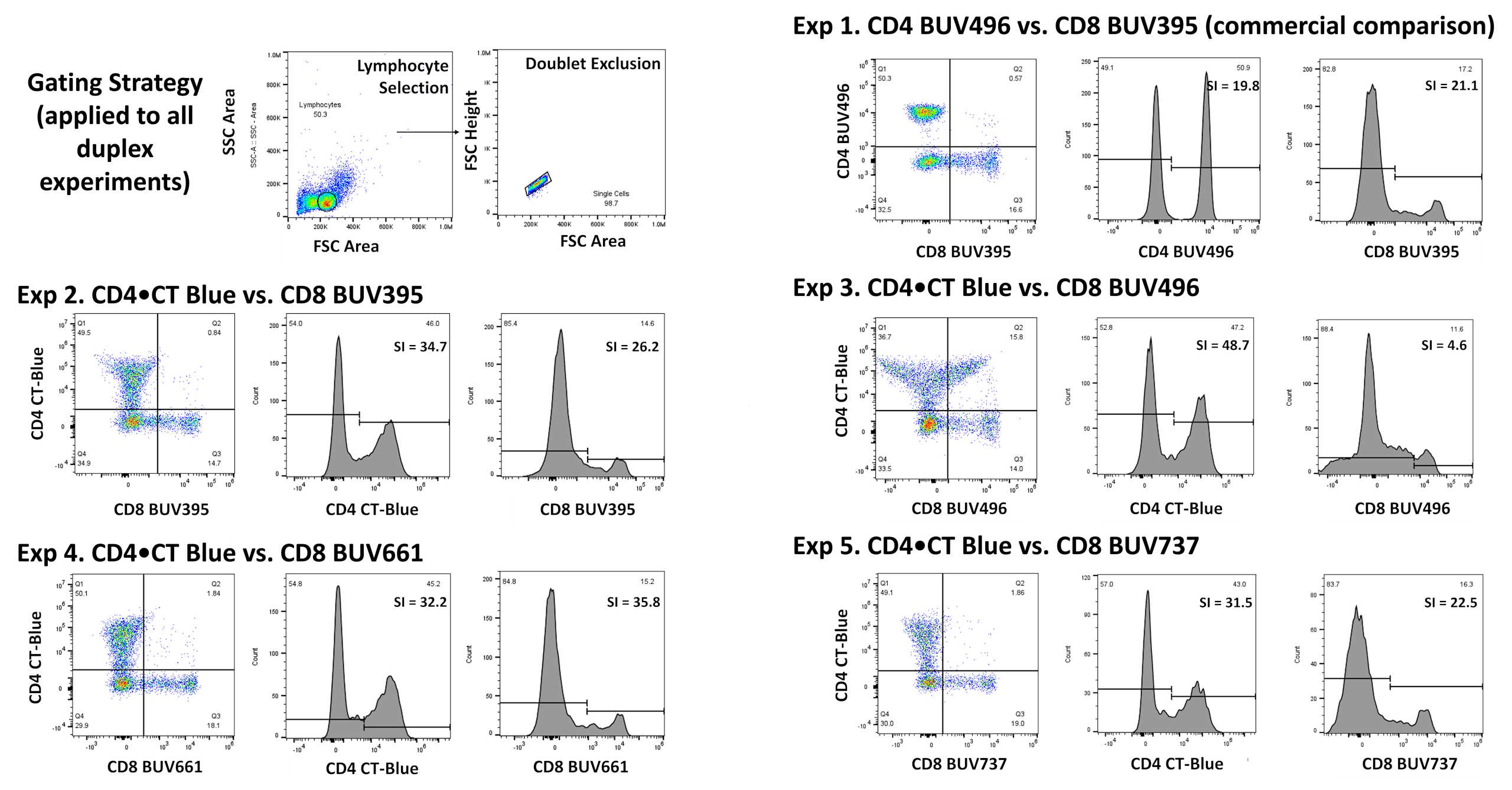
The CD4•CT-Blue conjugate was evaluated across four two-colour panels with four CD8 BUV conjugates. Despite the observed spread in the CD4+ population, likely attributable to a range of F/P ratios and the brightness of the CD4•CT-Blue conjugate, all 4 panels revealed the characteristic “L-shaped” distribution required for the identification of mutually exclusive CD4+ and CD8+ T-cell populations, establishing CT-Blue as a functional flow cytometry fluorochrome. All data was acquired on the SONY ID7000 (7 laser configuration).
Spectral Signature Comparison
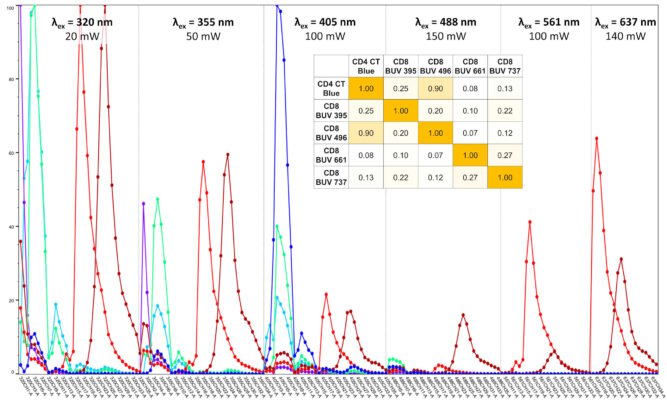
- High spectral similarity (0.90) between CD4•CT-Blue and CD8 BUV496 accounts for the significant “trumpeting” spread observed on bivariate plots.
- Reduced similarity between CD4•CT-Blue and CD8 BUV395 (0.25) correspondingly produces reduced spreading error in their respective bivariate plot.
- Low similarity with CD8 BUV661 (0.08) and CD8 BUV737 (0.13) correlates with minimised spread.
ChromaTwist Conjugatable Dye Targets
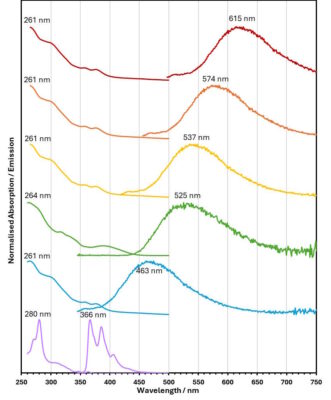
We are currently manufacturing an additional six dye colours (Figure 3) for antibody conjugation and flow cytometry testing, with the further capability to create bespoke designer colours via modulation of the emissive unit in Figure 2. We currently have ~70 different emissive unit emitting 365nm-630nm.
The ChromaTwist Technology is modular and we can introduce functionalities such as: acids, active esters, azides, alkynes, thiols, sulphonates, PEGs and amines.
Currently, we have used:
- active esters to conjugate to antibodies
- active esters/azides/alkynes to couple to scaffolds
Commercial Opportunities and Collaboration with ChromaTwist
Reagent Supply & Modularity: ChromaTwist is manufacturing functional dyes (for example: acids, active esters, azides, alkynes, thiols, sulphonates, PEGs, amines) to enable partners to seamlessly develop their own custom conjugates.
Portfolio Integration: Potential partners interested in incorporating (supply or license) ChromaTwist’s unique fluorochromes into their existing commercial antibody conjugate product portfolios are invited contact Jon Preece.
End-User Evaluation: High-parameter flow cytometry end-users interested in evaluating our novel dyes within their multi-colour panels are invited contact Jon Preece.